
On January 20, 2007, MotoringFun.com sponsor, MyMini, hosted a “Winter Dyno Day” in South Florida. Granted, most will not consider 68 degrees winter weather, but I’ll take it! We had approximately 15 MINIs come out for this event, inlcluding my own 2006 MINI Cooper S, known as “Scooter”. I had been eagerly anticipating this dyno day for a few months as I wanted to get a baseline dyno reading on my car in stock configuration before the modifications began. The modifications that are planned are not extreme by any means, however, before I started upgrading parts I wanted to see what our friends from Oxford gave me.
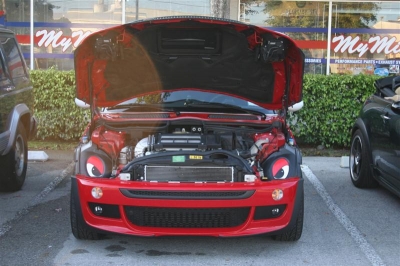
Let’s start by listing Scooter’s specifications:
2006 MINI Cooper S (Chili Red with White Roof & Mirrors)
Premium Package
Sport Package (with 17″ S-lites and Dunlop Run Flats)
Limited Slip Differential
Aero Kit w/ Fog Blackouts
Rear Fog Light
Chrome Line Interior
Harmon Kardon Audio
iPod Adapter
AUX port
Next, letís list the modifications that are planned:
JCW Exhaust
MyMini Resonator Eliminator
JCW Airbox
MyMini 15% Supercharger Reduction Pulley
Enkei Evo 6 Anthracite Wheels
Hankook Ventus Rs2 Z212 Tires
Maybe a few other items to compliment the above
My goals for the dyno weekend were:
1. Do a baseline run
2. Add the JCW exhaust with the MyMini resonator eliminator
3. Perform another run
4. Install the JCW airbox
5. Perform another run
6. Modify the JCW airbox by unhooking the flap in the back of the box so that it stays open all the time instead of just over 4500 rpms
7. Perform another run
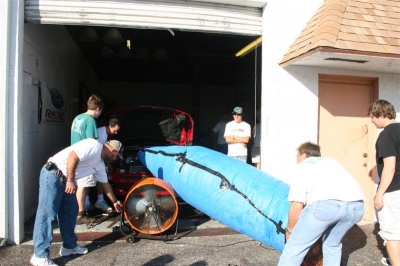
The air temperature in South Florida that day was in the high 60ís/low 70ís. We used two fans. One of which was modded by BahamaBart who installed a wind tunnel contraption made out of tarp to direct the air over the intercooler (pretty slick idea).
With the car completely stock as outlined above, Scooter produced the following numbers on the first run:
Max Wheel Horsepower: 163.13hp
Max Torque:148.51 lb-ft
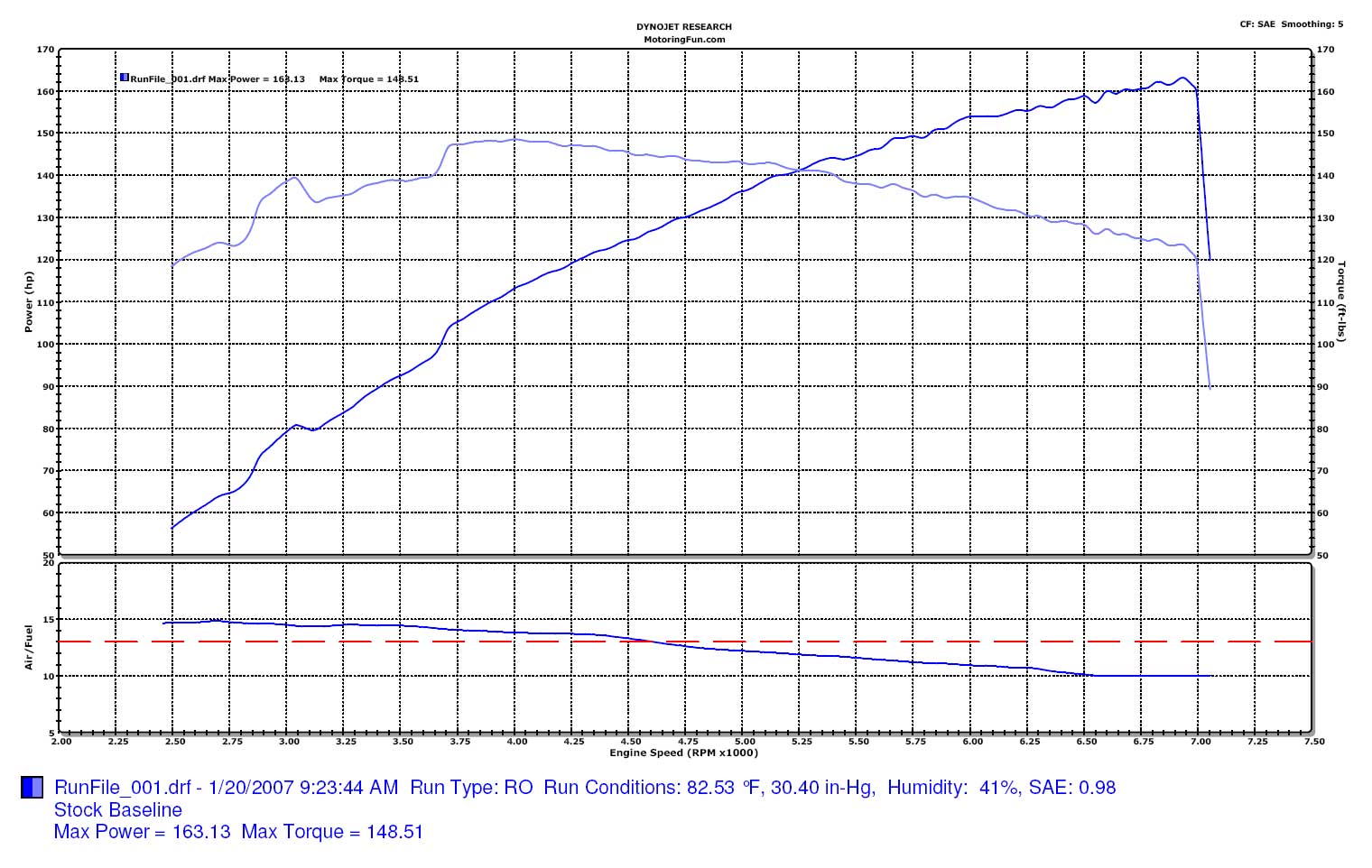
Considering that MINI advertises 168bhp / 162 lb-ft at the crank, to pull 163 at the wheels is amazing. From what I have researched, the drivetrain loss is between 10%-12%. For argument sake, letís figure 11% as a happy medium. Given an 11% drivetrain loss, that is:
Max Horsepower (at the crank): 181.07hp
Max Torque (at the crank): 164.85 lb-ft
Once the baseline run was complete, the first performance modification was installed ñ the JCW exhaust with the MyMini Resonator Eliminator. I will be working on a review of this exhaust system with the MyMini pipe once I have had a chance to drive it for a bit, but for the purposes of this article, I will focus on the dyno effects it has on the car. I was not sure what I was expecting here since I had read various threads about exhausts and people claiming that their exhaust increased horsepower by this much or that personís exhaust increased horsepower by that much. From conversations with some of the MotoringFun.com chat room regulars (some who are MUCH more mechanically inclined than me ñ granted that is not saying much!), I was also told not to expect ANY performance gains with any new exhaust until it is complimented with a cold air intake. In fact, I was told to not be surprised if my numbers actually dropped!
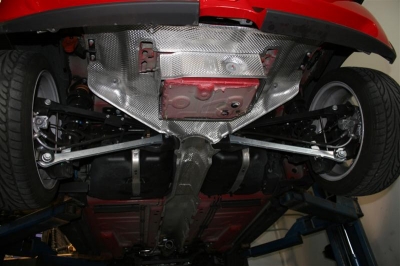
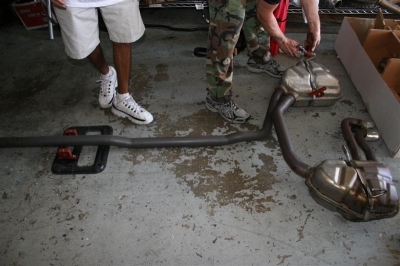
I decided that the only way to find out exactly what effects the exhaust will have on a completely stock car is to load it up on the dyno again. Once the exhaust was installed, we put Scooter back on the rollers and got the following results:
Max Wheel Horsepower: 163.03hp
Max Torque: 148.27 lb-ft
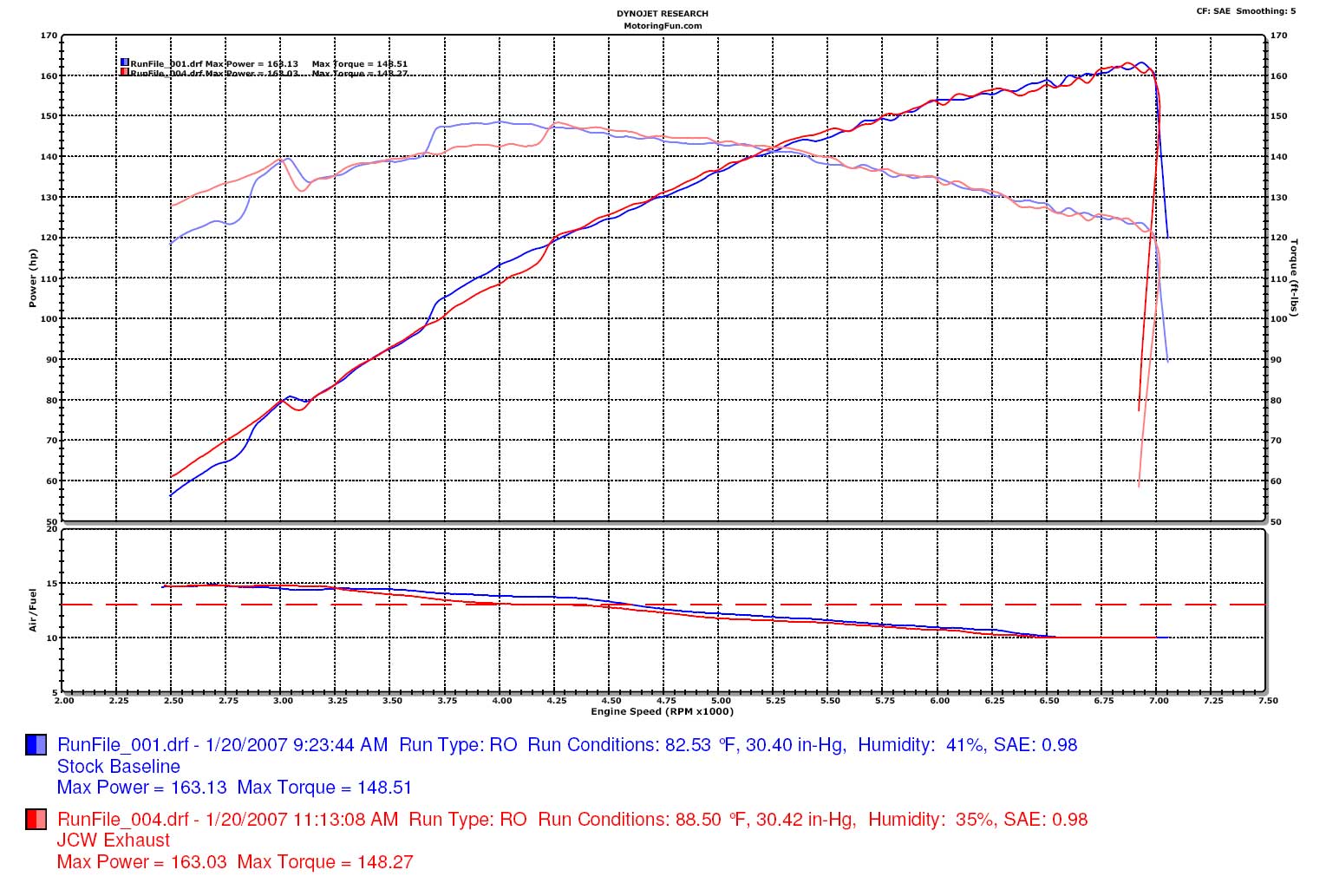
As you can see, the numbers actually dropped ever so slightly. I took the car for a test drive just to see if I noticed any difference. Even though the numbers showed no improvement, the car felt lighter and, as a result, quicker. Given that the stock exhaust is SOOO heavy compared to the JCW exhaust, it makes sense.
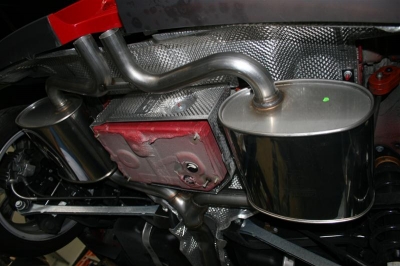
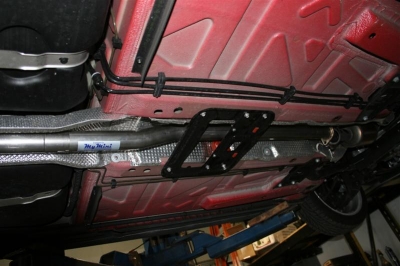
Ok, now that the exhaust is on and the dyno numbers have been recorded, it is time to move on to the JCW intake installation. As you may already know, the JCW intake is a smart little intake that opens an additional flap once you reach 4,500 rpms. This gives the car a slight boost in power and supercharger whine when you get on the gas for spirited driving.
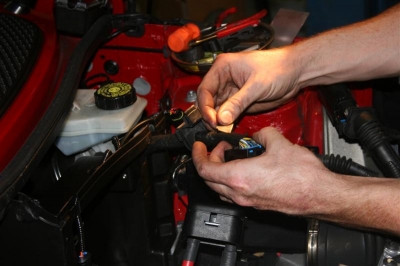
After about 45 minutes, the intake was installed and we loaded up Scooter on the dyno once again and got the following results:
Max Wheel Horsepower: 168.43hp
Max Torque: 149.30 lb-ft
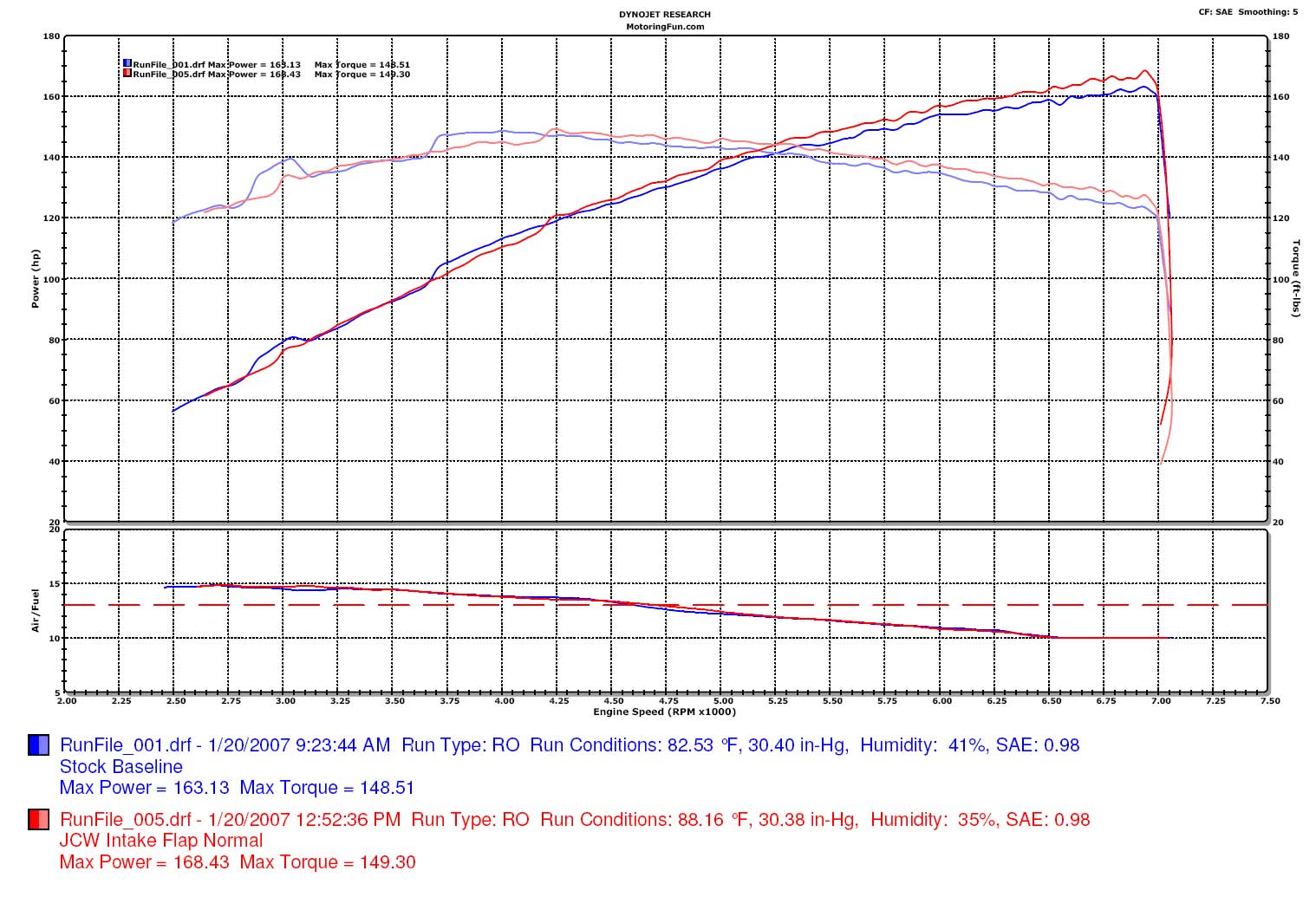
Now we finally are seeing an improvement in performance. The combination of the exhaust and intake produced about a 5.5 hp gain and about 1 lb-ft of torque. Taking Scooter for a test drive was a joy. Once I passed 4,500 rpms, the car had a noticeable increase in torque which made for nice acceleration. Under 4,500 rpms, however, the difference was not much more over the difference I experienced with the lighter exhaust.
So what next? I have read multiple threads on the net and spoken to others who have the JCW intake and all have suggested that I keep the JCW intake flap open at all times instead of just when the engine is revving over 4,500 rpms. The modification is simple enough ñ just reach back into the flap opening and unhook the plunger that opens and closes the flap. This keeps the flap in the open position at all times. Once this was done, we loaded Scooter back up on the dyno and saw the following results:
Max Wheel Horsepower: 167.46hp
Max Torque: 151.72 lb-ft
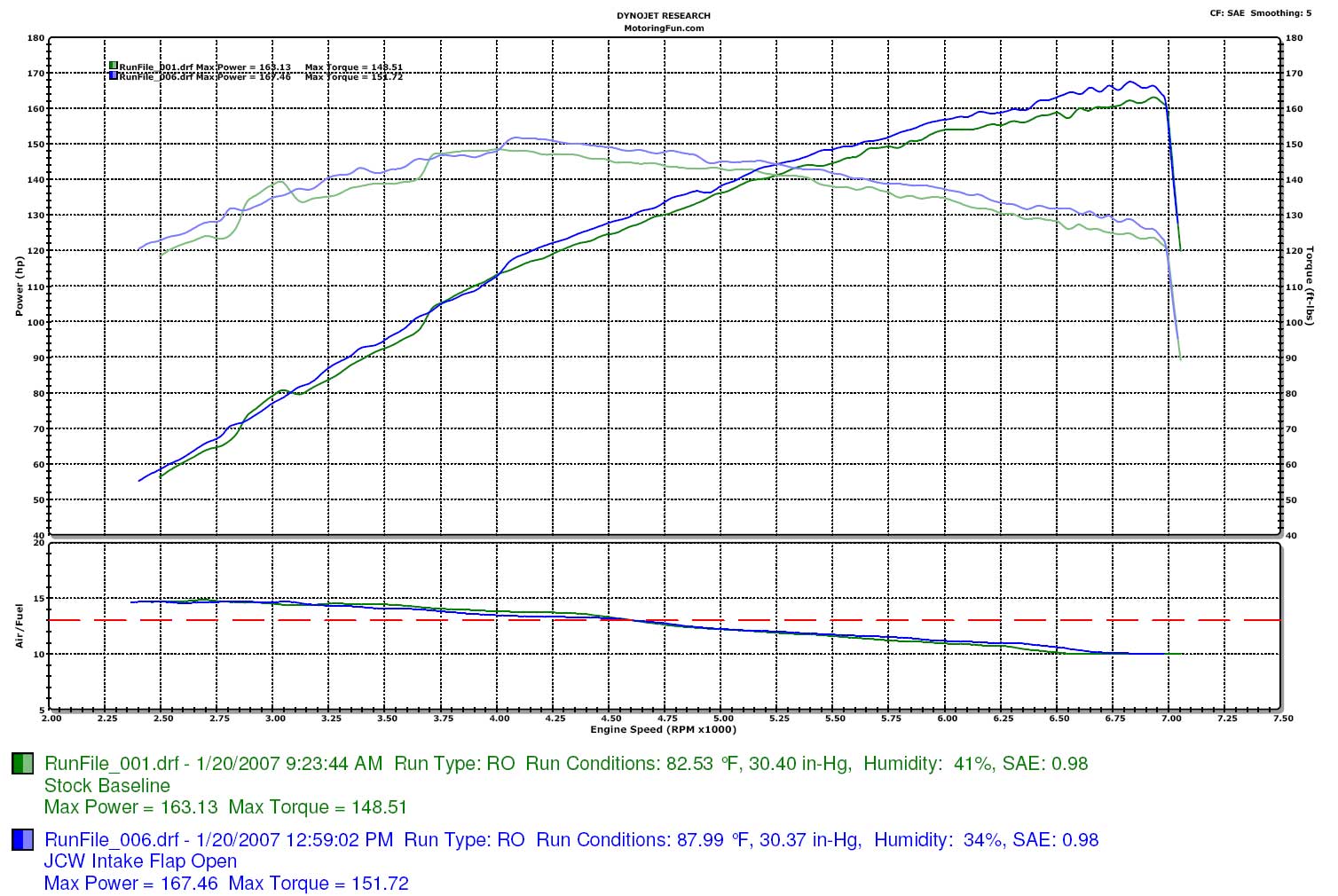
At first I was a bit concerned that I lost 1hp until I looked at the torque graph. Just having the flap open created about 2.5 lb-ft of max torque, but more importantly resulted in a higher torque curve across the rpm range, giving the car some extra bite down low. Taking Scooter out for a test drive, I was absolutely amazed at the difference. The car just pulls so nicely right from the start. The extra supercharger whine is not obnoxious and adds to the feeling of power.
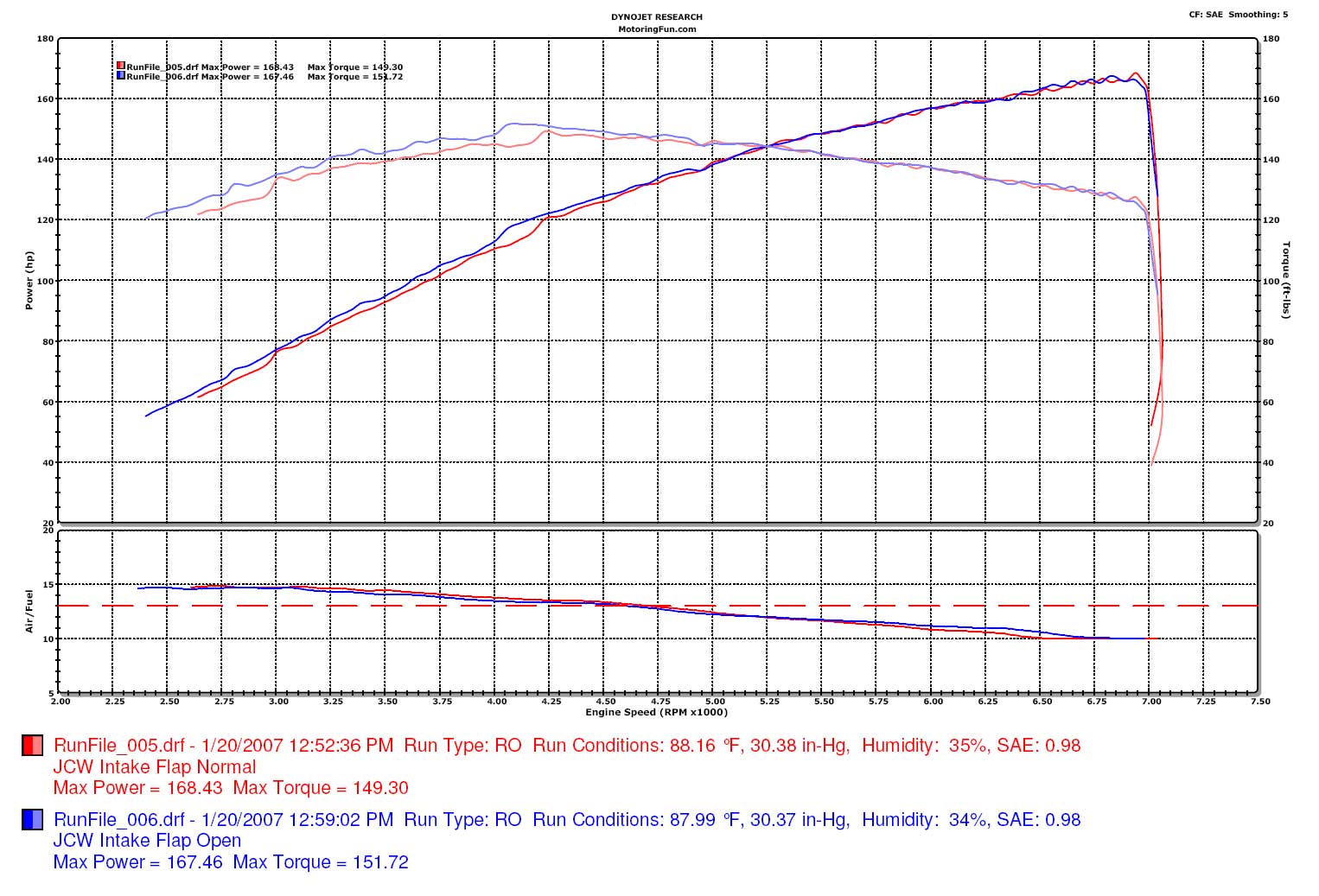
After showing my results to a few gearheads (see above graph for a comparison of the JCW intake with flap open and closed), the consensus was to leave the flap open and that the 1hp loss could be attributed to many factors (ie. error tolerance on the dyno, temperature of the IC on the last run, etc.). The feeling was that I probably did not even lose the 1hp, but even if I did, the gain in torque was well worth it.
All in all, I am thrilled with the results of the first modifications to my car. It is almost like having a new car all over again. Next on the list is a 15% reduction pulley and installing my new wheels and tires. Once that is complete, I hope to return to the dyno to get some updated numbers.
Check back soon for more on the MyMini Winter Dyno Day . I will post a review of the JCW exhaust with the MyMini resonator eliminator and also have some dyno results from other MINIs that were there that day. Some very interesting findings, including some amazing numbers put down by MyMini-equipped cars!
[ MyMini Dyno Day – Part 2 ]
[ MyMini Winter Dyno Day Gallery ]
##NOLIGHTBOX##
I think this a great review!!! It was a fun day and I enjoyed being part of it. I want to be included in the “rerun”. Please let me know when it is. I posted 183.75 whp, I forget the torque numbers on my run.. But since then, I have done some “tweeking” be interested to see what happens.
Thanks Marc – I will be posting more dyno graphs from other cars that were there that day…
Nice write up from which many can benefit from. Had a blast that day and enjoyed meeting you and your car.
Running all those back to back runs had to hurt your numbers. I would believe your hp numbers are stronger. Do the baseline again when the car is cold and see what they are. Also change out the JCW filter for more air flow.
Did the dyno operator point out that your air/fuel ratio goes way out to stoich. corresponding directly with your loss of torque in every run? Their’s probably a good reason to go that rich (prevent detonation at full boost???) between 4 and 5 k, but I’d definitely be wanting to find out more about that. Thanks for the dyno graphs. Very helpful to see.
Great write up. Looks like you had a fun filled day.
Great write-up Pedro.. very easy read for all those like you and I not so mechanically inclined.. looking forward to see your results after the pulley installed…
excellent write up! great to put the $ where the mouth is and actually see some tangible results.
Great write up. Its nice to see real numbers with results. I get tired of all the hear say.
i cant wait untill the next dyno day!
Thanks for the great feedback guys! As for the car running rich, we found that all the MINIs run rich on the OEM ECU. I will see where I am at after the pulley install tomorrow!
Pedro, when you say that the open valve was not that obnoxious at lower rpm, what can you compare it too?
Neil, it is not all that loud at all at low RPMs… I would say you hear the supercharger a tad more than stock. I will be posting an article on how to open the flap without removing it, allowing you to leave it open or closed at will… Stay tuned!